A good roofing website has one main job: to convince a cautious homeowner, often right after a storm and often with a door-knocker’s flyer in hand, that you are a real, local, licensed company they can trust with a five-figure project. That means clear proof (license, insurance, real project photos, genuine reviews), separate pages for repair, replacement and storm damage, an estimate request that takes under a minute, and insurance wording that stays inside your state’s law.
This guide covers how roofing buyers actually decide, the pages and features that turn searches into inspections, how to prepare your site before storm season instead of scrambling after it, and the local SEO basics that help roofers show up on Google.
Most people buy a roof once or twice in their lives, and most published 2026 cost guides put a typical asphalt shingle replacement somewhere around $10,000 to $15,000, with metal, tile or large homes going well above that. A purchase that big and that rare makes buyers careful. They usually compare two or three companies, and your website is often where they decide who gets the inspection.
What they look for, roughly in this order:
If your homepage answers those four questions quickly on a phone, you are ahead of many roofing sites that open with a stock photo and a vague slogan.
Different searches need different pages. Grouping everything on one “Services” page makes it hard for Google to match you to specific searches and hard for visitors to find their situation.
| Page | Searches it can match | What the page must include |
| Roof repair | “roof leak repair near me,” “missing shingles repair” | Common problems you fix, how fast you respond, how repair pricing works, when repair stops making sense |
| Roof replacement | “roof replacement [city],” “new roof cost” | Your process step by step, materials offered, what affects price, warranty, financing (if you offer it) |
| Storm and hail damage | “hail damage roof repair,” “storm damage roofer” | Signs of damage, what to do first, how inspections and documentation work, a clear note on how you handle insurance claims |
| Material pages (shingle, metal, tile, flat) | “metal roof installation [city]” | Pros and cons, typical lifespan ranges, maintenance, photos of your own installs |
| Projects or gallery | Brand and trust searches | Before-and-after photos, city, roof type and a short description of the problem and the fix |
| About, licenses and reviews | “[company name] reviews,” “[company name] license” | Owner and crew photos, license and insurance details, genuine reviews, years in business |
Only build pages for services you actually want to sell. A thin page that says “We also do gutters” adds little; a short, honest page that explains gutter replacement with your own photos can bring in steady add-on work.
If you work across several towns, a page for each main area can help, but only if each page is genuinely different: the neighborhoods you cover, projects you completed there, local weather issues (hail in one area, coastal wind in another) and local permit notes. Copying one page and swapping the city name is what Google’s spam policies call doorway pages, and it can drag down the whole site.
In roofing, proof beats adjectives. These elements carry the most weight:
Storm work is a big share of revenue for many roofers, and it is where websites most often cross legal lines. This section is general information, not legal advice. Check your state’s rules with an attorney or your state’s insurance department before publishing claim-related copy.
| Risky wording | Why it is a problem | Safer alternative |
| “We’ll cover your deductible” or “No out-of-pocket cost” | Texas and Colorado, among many other states, prohibit contractors from offering to waive, rebate or absorb a homeowner’s deductible on insurance-funded work. | “We’ll explain your estimate line by line so you know exactly what your policy covers and what you owe.” |
| “We negotiate with your insurance company for you” | In several states, a contractor can’t act as or advertise as a public adjuster on a property they will repair. The Texas Department of Insurance notes this applies to advertising too. | “We document the damage with photos and a detailed estimate you can share with your insurer.” |
| “Free roof from insurance!” | Misleading: coverage depends on the policy, the damage and the insurer’s decision. | “If you have storm damage, a free inspection tells you whether filing a claim makes sense.” |
| “Guaranteed claim approval” | You don’t control the insurer’s decision; promising an outcome can be treated as deceptive. | “We’ve helped homeowners through the claim process since [year]. Here’s how it works.” |
A plain “How insurance claims work” section in this careful tone keeps you within the law and reassures homeowners wary of storm chasers.
Searches for storm damage and roof repair tend to jump right after hail or high winds. If you build your storm page after the storm, you are already late. A simple preparation plan:
Buyers search for roofing prices constantly, but you don’t need a price list. A short section on your replacement page that explains what drives cost (roof size and pitch, tear-off layers, material, decking repairs, permits, access) and gives an honest range for a typical local job helps qualify leads and builds trust.
Some roofers add an instant estimate tool that uses aerial measurements. These can generate a lot of leads, but make it clear that the number is a preliminary range and that the final price comes after an inspection. If you advertise financing with specific terms, such as a monthly payment or an APR, federal Truth in Lending rules can require extra disclosures, so use the wording your lender provides. We covered financing wording in more detail in our HVAC website design guide, and the same principles apply to roofing.
Most roofing jobs start with a local search, so your Google Business Profile and your website work as a pair:
Our step-by-step local SEO checklist for contractors goes deeper on each of these. If you plan to run Google Ads during storm season, send that traffic to the storm page rather than the homepage; our guide to Google Ads landing page best practices explains why focused pages convert better.
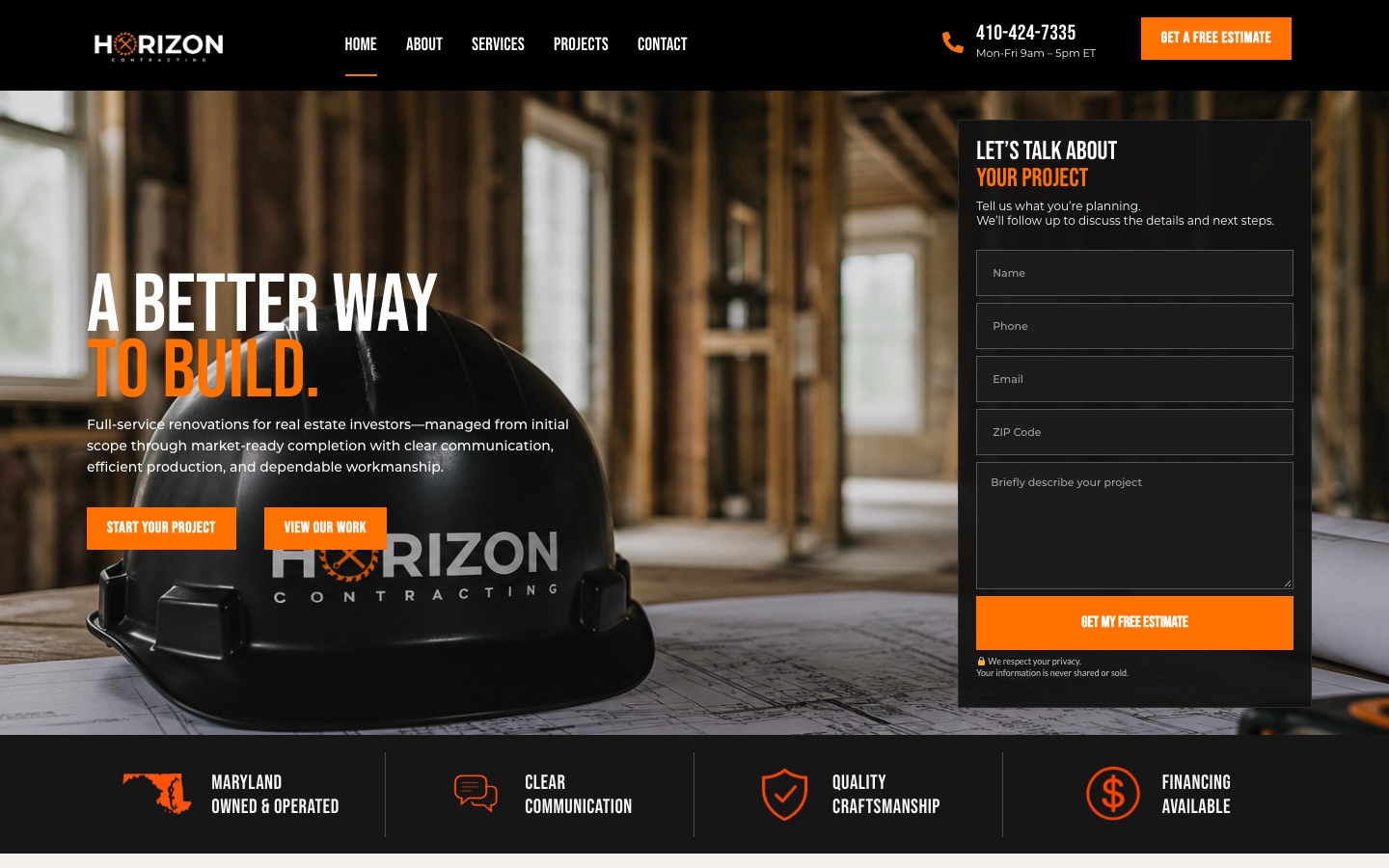
Cost depends on how many service, material and area pages you need, whether you want an instant estimate tool or CRM integration, and who supplies the photos and content. For reference, Blue IT’s website packages are Starter (up to 5 pages, delivered in 5–7 business days) and Growth (up to 10 pages plus a blog, with advanced SEO and speed optimization, delivered in 10–12 business days). Larger multi-location roofing companies are scoped as Enterprise projects. We confirm the exact scope and price in a free consultation. For a contractor example with a lead-focused free estimate form, see our Horizon Contracting case study.
A small roofing company can start with a homepage, separate repair, replacement and storm damage pages, one page per main material, a projects page, an about page and a contact page, often 8 to 12 pages. Add area pages and articles over time when you have real projects and local details to share.
A fixed price list rarely works because every roof is different, but explaining what affects cost and giving an honest local range for a typical replacement helps qualify leads. Always state that final pricing follows an inspection.
You can explain that you document damage and provide detailed estimates homeowners can share with their insurer. Avoid promising to waive deductibles or to negotiate claims for the homeowner; both are restricted in many states. Check your state’s specific rules.
They mainly help conversions, but project pages with real photos, the city and the roof type also give Google original content. Use descriptive alt text and compress images.
A focused site can launch in a few weeks. Gathering license details, project photos and reviews usually takes longer than the build itself, so start collecting them early, ideally before storm season.
Blue IT Technologies has been designing mobile-friendly, SEO-ready websites for local service businesses since 2015. Explore our website design services and local SEO services, or contact us for a free consultation about your roofing website.

Talk to our team about your project. Book a free consultation, no obligation.