Someone looking for a therapist is rarely browsing casually. They may have put off the search for months, they are often anxious, and many will leave if the first contact step feels confusing or exposing. A good therapist website lowers that barrier: within a few seconds it tells visitors who you help, how you work, what it costs, whether you take their insurance, and exactly how to reach out, in a tone that feels calm rather than salesy.
This guide follows a prospective client from the first search to the first message, and shows what your website needs at each step. It also covers the privacy, pricing-notice and telehealth details that are easy to get wrong, because on a therapy site the technical choices are part of the trust you are asking for.
Key Takeaways
- Lead with who you help and how, in plain words, not a list of credentials and modalities.
- Answer the three practical questions early: fees, insurance and availability (including telehealth).
- Offer more than one low-pressure way to make contact, such as a free consultation call, a short form or a booking link.
- Treat privacy as part of the design: keep sensitive details out of plain web forms and be careful with advertising pixels.
- If you see self-pay or uninsured clients, check the No Surprises Act Good Faith Estimate notice requirement for your website.
The Client’s Path to a First Session
It helps to plan the site around the questions a hesitant visitor asks, in roughly the order they ask them.
| Visitor’s question |
What the site should show |
Where it belongs |
| “Is this person for someone like me?” |
The people and concerns you work with, in everyday language |
Homepage headline and first section |
| “Will I feel comfortable with them?” |
A real photo, a warm personal bio, how a first session works |
About page, homepage preview |
| “Can I afford it?” |
Session fees, insurance accepted or out-of-network help, sliding scale if offered |
Fees and insurance page, linked from the menu |
| “Can I actually get in?” |
Whether you have openings, waitlist status, in-person location and telehealth states |
Homepage and contact page |
| “What happens if I reach out?” |
What the consultation call involves, response time, what to include (and not include) in a message |
Contact page, near every call to action |
If your site answers these five questions clearly, you are ahead of many private practice sites, which often open with a stock image of a calm lake and a paragraph of clinical terms.
Pages a Therapist Website Needs
Homepage
Open with a specific line, for example “Therapy for adults dealing with anxiety, burnout and life transitions, in Austin and online across Texas.” Follow it with a short paragraph in your own voice, a clear button such as “Book a free 15-minute consultation,” and quick links to your specialties, fees and contact page. Keep it calm: plenty of white space, readable type, no auto-playing video.
About page
This is often the most-visited page after the homepage. Use a recent, natural photo of yourself, explain why you do this work and what sessions with you feel like, then list your license type, license number where your state requires it, training and approaches you actually use. Write for the client first and the credentials second.
Specialty pages
Give each main area you treat its own page, such as anxiety, couples counseling, trauma or teen therapy, but only for areas where you are trained and want referrals. A useful specialty page describes how the issue shows up in daily life, how you approach it, what progress can look like (without promising outcomes) and how to start. These pages also help you appear for searches like “couples therapist in Denver.”
Fees and insurance page
Many visitors leave because they can’t find costs. State your session fee and length, which insurance plans you are in-network with, whether you provide superbills for out-of-network reimbursement, your cancellation policy and any sliding-scale options. This is also the natural home for your Good Faith Estimate notice (see below).
FAQ page
Answer the questions people are embarrassed to ask: what the first session is like, how long therapy usually lasts, whether sessions are confidential and the limits of confidentiality, and what happens if they decide you’re not the right fit.
Contact page
Offer a phone number, a booking link if you use one and a short form. Add a clear crisis line note, such as: “If you are in crisis or thinking about harming yourself, call or text 988 (the Suicide and Crisis Lifeline) or call 911. This form is not monitored around the clock.” That line protects visitors and sets honest expectations.
Features That Help Hesitant Visitors Reach Out
- A free consultation option: a short phone or video call feels far less risky than booking a full session.
- Online scheduling: many practice management platforms (for example SimplePractice, TherapyNotes or Headway) offer booking widgets or client portals you can link to or embed.
- Availability status: a simple “Currently accepting new clients” or “Waitlist open” note saves everyone time.
- Mobile-first layout: many people search for help on their phone, often late at night. Buttons should be easy to tap and forms short.
- Accessibility basics: strong contrast, readable font sizes, descriptive link text and labeled form fields help visitors with different needs and devices.
- Directory profiles that match: if you use directories such as Psychology Today, keep the specialties, fees and photo consistent with your site so the visitor recognizes you.
Privacy: The Part Most Therapy Sites Get Wrong
This section is general information, not legal advice. Talk to your attorney, compliance consultant or professional association about your specific situation.
Contact forms
A standard website form usually sends messages through ordinary email, which is not built for health information. Keep the form short (name, preferred contact method, phone or email, and a general reason such as “individual therapy”) and add a line asking people not to share detailed personal or medical information until you have spoken. If you want intake details collected online, use a secure intake form or client portal from a vendor that will sign a Business Associate Agreement (BAA), if you are a HIPAA covered entity.
Tracking pixels and analytics
In 2022 the U.S. Department of Health and Human Services (HHS) issued guidance warning that tracking technologies on health websites can disclose protected health information. In June 2024 a federal court in Texas vacated part of that guidance, the part covering unauthenticated public pages, and HHS dropped its appeal that August. Other parts of the guidance, including tracking on logged-in pages such as client portals, are generally understood to remain relevant, and state privacy laws still apply.
The commercial risk is real too. In 2023 the FTC finalized an order requiring the online therapy company BetterHelp to pay $7.8 million over allegations that it shared consumers’ health information with platforms such as Facebook and Snapchat for advertising after promising to keep it private (BetterHelp denied the allegations). The practical lesson for a private practice: don’t install advertising pixels on contact, booking or intake pages, review exactly what your analytics tool collects, and say plainly in your privacy policy what you track.
Testimonials
Most professional ethics codes for psychologists, counselors and social workers restrict soliciting testimonials from current clients, because of the pressure it can place on them. Check your own code and state board rules before adding reviews to your site; many therapists rely instead on a strong bio, clear explanations and professional endorsements.
Pricing Notices and Telehealth Rules to Check
Good Faith Estimate notice
Under the No Surprises Act, providers, including mental health providers, must give uninsured and self-pay clients a Good Faith Estimate of expected charges. Professional associations such as the American Psychiatric Association and the American Counseling Association note that the right to a Good Faith Estimate must also be displayed prominently on your website, in your office and wherever scheduling happens. CMS offers a model notice. Putting it on your fees page, with a link from the footer, keeps it easy to find.
Telehealth across state lines
Therapists are generally licensed where the client is located during the session, not only where the therapist sits. Interstate compacts such as PSYPACT (for psychologists) and the Counseling Compact (for professional counselors) are expanding where some clinicians can practice, but states join and go live at different times. List only the states where you are currently authorized, check the official compact maps before you update the list, and avoid wording like “therapy anywhere in the U.S.” unless it is true for you.
Therapist Website Checklist
- Homepage headline says who you help, how and where
- Real, recent photo and a client-focused bio
- License type, number (where required) and genuine training listed
- Separate pages for your main specialties
- Fees, insurance, superbills and cancellation policy easy to find
- Good Faith Estimate notice posted if you see self-pay or uninsured clients
- Free consultation or booking option on every key page
- Short contact form with a “please don’t share medical details” note
- 988 crisis line notice on the contact page
- No advertising pixels on contact, booking or intake pages
- Telehealth states listed accurately
- Privacy policy that matches what the site actually tracks
- Tested on a phone for speed and easy tapping
Getting Found: Local SEO and Ads for Therapists
Most clients search phrases like “therapist near me,” “anxiety therapist [city]” or “couples counseling online [state].” A complete Google Business Profile (if you have an office clients visit), helpful specialty pages and consistent details across directories cover the basics. If you advertise, be aware that Google applies extra rules to healthcare ads, and that ad landing pages need the same privacy care as the rest of the site; our guide to
Google Ads landing page best practices explains how to build focused pages. Already have a site and planning a rebuild? Use our
website redesign SEO checklist so you don’t lose the search traffic you have.
What a Therapist Website Costs
A solo practice usually needs a homepage, about page, a few specialty pages, fees and FAQ, and contact, which fits well within a small package. For reference, Blue IT’s Starter package is $399 one-time (up to 5 pages, 7–10 business days) and Growth is $699 one-time (up to 10 pages plus a blog, with advanced SEO and speed optimization, 14–18 business days); group practices with many clinicians can get custom pricing. For an example of a counseling site we built, see our
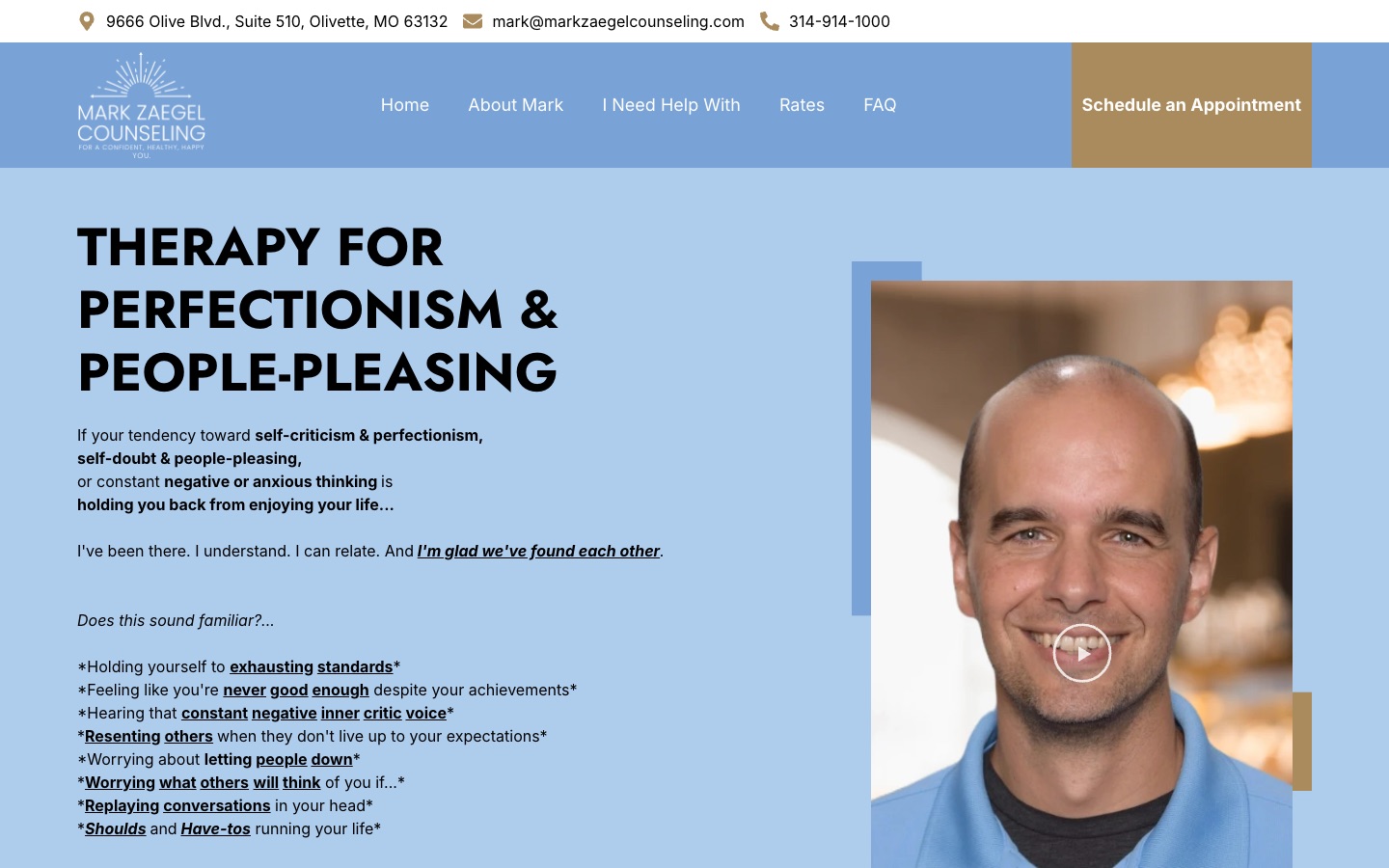
Mark Zaegel Counseling case study. If you are still comparing providers, our list of
questions to ask a web design agency will help.
Frequently Asked Questions
Should therapists list their fees on their website?
In most cases, yes. Clear fees and insurance details filter out poor-fit enquiries and reassure people who are worried about cost. If fees vary, give a range and explain what affects it.
Do therapist websites need to be HIPAA compliant?
A public website by itself is not usually where client records live, but forms, booking tools and portals that collect health information can be. If you are a covered entity, use vendors that sign a BAA for anything that handles client information, and keep ordinary contact forms minimal. Check the details with a compliance professional.
Can I use Google Analytics on my therapy website?
Many practices do, with care: keep tracking off intake and portal pages, avoid sending form contents or detailed page data to third parties, and disclose your tracking in your privacy policy. Rules continue to evolve, so review your setup with your compliance advisor.
How many pages does a therapist website need?
A solo practice can launch with five to eight pages: home, about, two or three specialties, fees and insurance, FAQ and contact. Add a blog or more specialty pages later if you have useful things to say.
Should I add client testimonials?
Be cautious. Many professional ethics codes restrict soliciting testimonials from clients. Review your code of ethics and state board rules first.
Make Reaching Out Feel Easy
Founded in 2015, Blue IT Technologies builds clear, mobile-friendly websites for small practices and service businesses, with 2,300+ five-star client reviews. Explore our
website design services or
contact us for a free consultation about a website that helps new clients take the first step.